A "championship" within Fourball can be a serious multi-round event, or a few rounds on a trip to Spain with your buddies. Setting it up is simple — just fill the championship field on rounds as you create them. Fourball does all the hard work for you.
Why Run a Championship?
Regular events are great, but they're isolated events. A championship ties them together. Members who missed the last round have something to play for next time. The group chat stays active between events. And the end-of-tournament prize-giving actually means something.
- Engagement: Members are more likely to commit to dates when there's a running competition
- Fairness: Multi-round formats reward consistency over a single lucky day
- Drama: Late-season comebacks and final-day showdowns keep things exciting
Choosing Your Format
Option 1: Cumulative Stableford Points
The simplest and most popular format. Each round is scored on Stableford, and points accumulate across the season. The player with the most total points at the end wins. This works because Stableford is already handicap-adjusted, so it's fair across all abilities.
- Pros: Easy to understand, every point matters, works with any number of rounds
- Cons: Missing a round is a major disadvantage unless you allow "best X of Y" scoring
Option 2: Best Rounds Count
Play 6 rounds across the season, but only the best 4 count toward the championship. This forgives absences and bad days, making it fairer for members who can't make every event.
Option 3: Points-Based Order of Merit
Award points based on finishing position in each round (e.g., 1st = 10 points, 2nd = 8, 3rd = 6, etc.). This rewards consistent top finishes rather than raw Stableford totals.
How Individual Rounds Work
Each championship round functions as a standalone event. Players enter scores hole-by-hole on their phones, and the leaderboard updates in real time. Here's what a typical single-round leaderboard looks like:
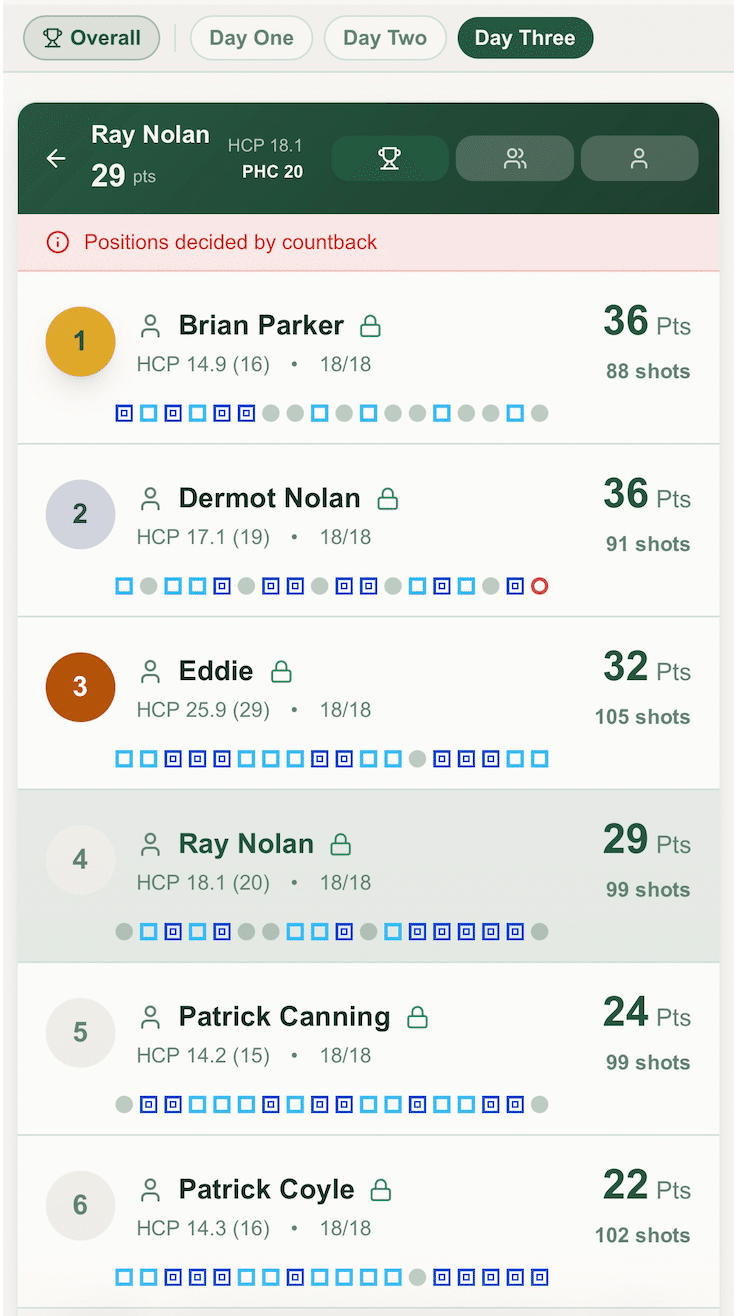
Each player's position, handicap, and Stableford points are visible at a glance. Scores update live as groups progress through the course, so spectators (and players waiting on the next tee) can follow the action.
The Multi-Round Championship Leaderboard
After each round, the championship leaderboard aggregates scores across all completed rounds. This is where the real story of the season unfolds:
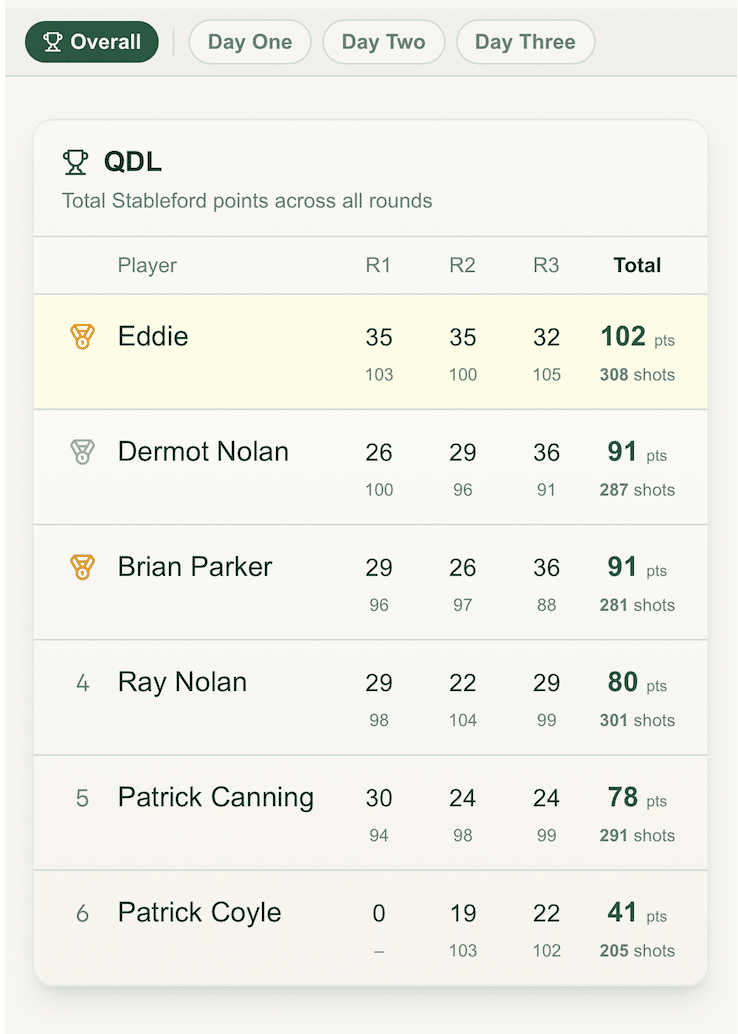
The championship view shows each player's points per round alongside their cumulative total. This makes it easy to see who's been consistent, who had a breakout round, and who's still in contention heading into the final event.
Setting Up a Championship in Fourball
With Fourball, creating a multi-round championship takes just a few steps:
- Create the championship: Give it a name (e.g., "2026 Summer Championship") and set your handicap percentage
- Add rounds: Each time you play, create a new round and link it to the championship
- Share the link: Players access the championship leaderboard via a unique URL — no app needed
- Track automatically: As rounds are completed, the cumulative leaderboard updates itself
Handicap Considerations
For a fair championship, decide on your handicap policy upfront:
- Fixed handicap: Lock handicaps at the start of the season. Simple and transparent, but may not reflect improving (or declining) players.
- Rolling handicap: Update handicaps after each round based on performance. Fairer over a season, but requires more administration.
- Handicap percentage: Apply a percentage (e.g., 90% or 95%) to reduce the advantage for higher handicappers. Fourball lets you set this when creating the championship.
Practical Tips for Organisers
Schedule early
Handicap Considerations
Set minimum attendance
Require members to play a minimum number of rounds (e.g., 4 out of 6) to be eligible for the overall prize. This prevents someone playing only the easy courses and winning on a small sample.
Communicate standings regularly
Practical Tips for Organisers
Plan a proper finale
Make the last round an event — choose a great course, organise dinner afterwards, and do the prize-giving on the night. The championship should feel like it builds to something.
Example Championship Structure
Here's a template for a typical society season:
- Round 1 (March): Local course, season opener
- Round 2 (April): Away day at a guest-friendly course
- Round 3 (June): Mid-season — often the best weather
- Round 4 (July): The annual "big trip" round
- Round 5 (September): Penultimate round — pressure builds
- Round 6 (October): Season finale at the best available course
Best 4 of 6 count. Minimum 4 rounds played to qualify. Handicaps updated after each event. Championship leaderboard shared within 24 hours of each round.
Summary
A multi-day championship gives your golf society or away golf trip a backbone. It turns four standalone days into a connected event with genuine stakes and stories. Keep the format simple (cumulative Stableford works for most groups), communicate standings after every round, and use digital scoring to eliminate the admin burden. Your members will thank you — especially the one who wins by a single point on the last hole of the last round.